
Practical Omens, Pt.2
How folklore becomes lived experience

Next, the omens started to come.
And as any logic-abiding citizen, I didn’t take them seriously, because doing so would mean stepping onto shaky ground where I had no guidance but my own intuition, which over the years I often confused with anxiety. This type of journey requires a consistent sanity check within a community you trust, and a consistent practice with your body, where you engage with it not as a tool that moves you from point A to point B, but as a consciousness, as an ancestor that has its own knowledge you’re learning to understand.
I was having regular meetings with practitioners as part of a project I had started, and it changed the way I practice so much that it feels like I’ve grown tenfold since then. Even though technically I was the one teaching, it often felt that I’d learned just as much from the people who came to learn. Those moments of honest, vulnerable conversation created so much clarity in my mind that seeing and hearing things became more accessible. There may have been things I saw and heard in the past that I immediately discarded out of fear, but this spring something really shifted in my practice. Seeds that had been planted finally began peeking through the soil.
It started one morning while I was preparing breakfast, and during the chopping-vegetables meditation I was overcome with a feeling of disappointment and annoyance that my husband would feel because he had to go and fix our car on Saturday morning. Our car wasn’t broken at that moment. The feeling came as though it had already happened. It was the exact feeling I would experience the next day. At the same time. In the same spot. A déjà vu in reverse. Because that Friday afternoon I damaged the bumper, and he indeed had to spend Saturday morning fixing the car.

As I stood there in the kitchen making breakfast for my daughter the same way I had the day before, now actually standing inside that feeling of disappointment and annoyance that I imagined he felt (which he never expressed to me), something strange happened. Yesterday's self and today's self somehow linked, and for a split second my mind existed in two places at once.
By creating a pattern—a routine—in my daily life, I may have opened the possibility for this kind of connection.
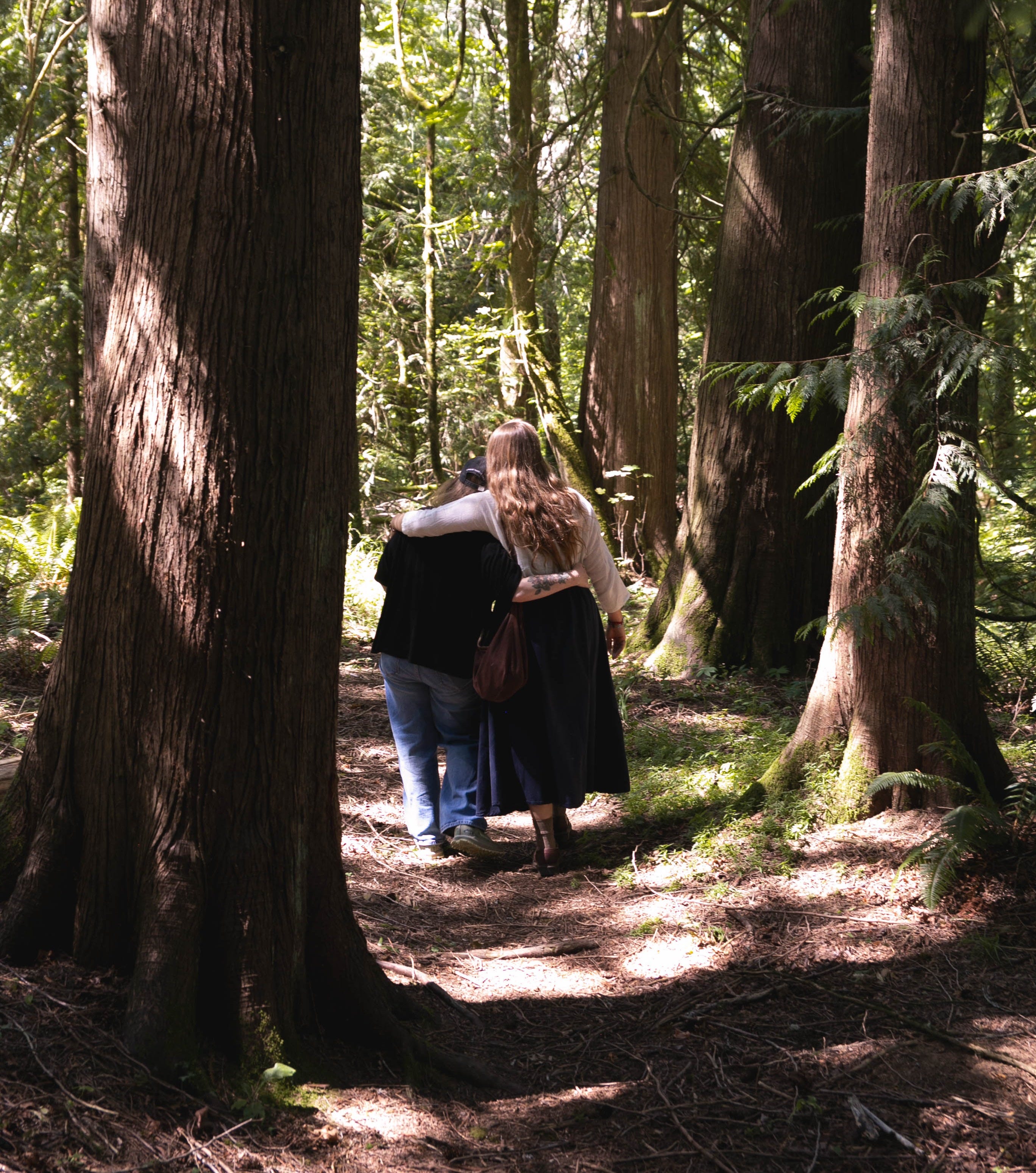
I’ve also been going to the same spot in nature. I walk the same path, sit in the same place, arrive with the same intention. The more faithfully I return, the stranger—and more specific—the encounters become. I’ve found lizard skins exactly where I normally sit, as though they had been left there for me to discover. I’ve watched a spider catch and wrap a butterfly from beginning to end—a process I’d somehow never witnessed so closely. I’ve overheard fragments of conversations drifting through the trees that seemed to answer questions I’d arrived carrying, despite the speakers being complete strangers. The most fascinating omens seem to come when I bring someone with me. The trees enjoy company.
Pattern recognition has always been one of my favorite ways of understanding the world. Long before I could put words to it, I was collecting small observations and wondering how they connected. It was only later that I realized generations of philosophers, sociologists, and storytellers had been asking similar questions from completely different directions.
Aristotle argued that character is formed through habit—that we become what we repeatedly do. Centuries later, Maurice Merleau-Ponty became interested in the body itself, suggesting that repeated movements become a kind of intelligence that no longer requires conscious thought. The sociologist Pierre Bourdieu would later describe this as habitus: the idea that our repeated practices don’t just shape our behavior; they shape the very way we perceive and move through the world. I’m certainly not the first person to wonder what repetition does to a human being. I simply find myself taking that conversation somewhere else.
Because I don’t think repetition only shapes who we are. I think it shapes what we’re capable of noticing. More than that, I think repetition creates relationship. By returning to the same place, following the same path, sitting on the same log, making breakfast in the same kitchen, I learned the ordinary so intimately that the extraordinary no longer had to shout to be noticed. Patterns stop feeling like isolated events and begin behaving like a language. What once looked like coincidence begins to reveal itself as relationship.
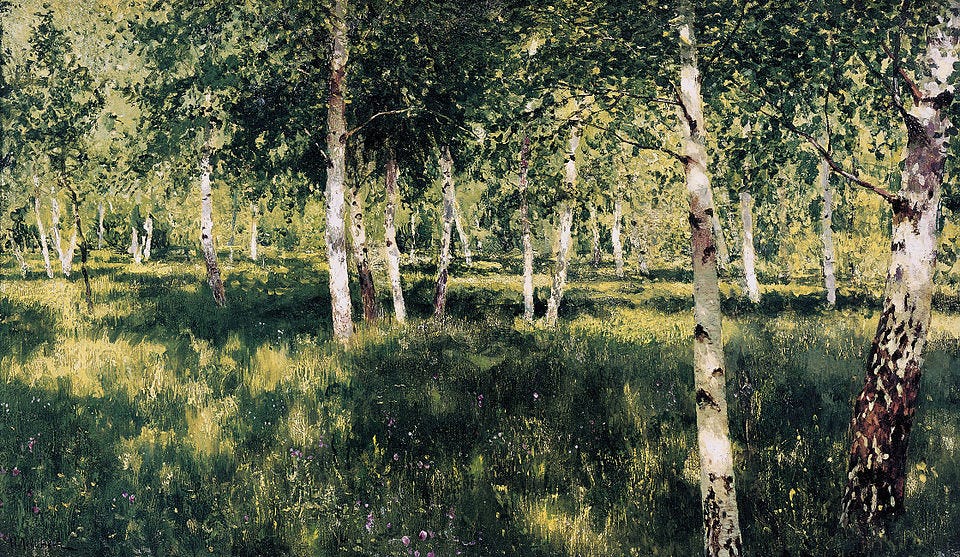
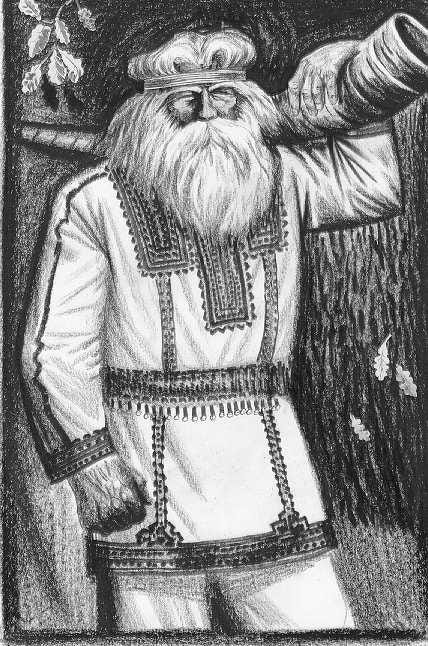
One of my favorite examples comes from the Erzya epic of Tyushtya, who is a legendary Erzya culture hero whose songs preserve memories of the Erzya people's encounter with colonization. Before the arrival of the Russians, Tyushtya walks through the forest and encounters something that wasn’t there before—a grove of white birches.
«Он ходил по темному лесу,
Он зашел в середину леса
И наткнулся на березовую рощу.
Встрепенулось его сердце,
Помутился его разум...»
“He walked through the dark forest.
He entered its very heart
And came upon a grove of birches.
His heart trembled.
His mind grew troubled.”
The appearance of the birch is meaningful because Tyushtya knows his landscape intimately enough to recognize that something has changed. A person unfamiliar with the forest would simply see another tree. Tyushtya sees the beginning of another world. The new tree becomes the first visible sign of an entirely new pattern unfolding.
Maybe that’s what practical omens really are. Not supernatural messages falling out of the sky, but moments when the world briefly reveals a pattern we’ve become fluent enough to recognize. Practice doesn’t make the world more magical. It makes us more attentive. Attention, repeated over time, becomes relationship. Once you’re in relationship with a place, a landscape, a body, or even a morning routine, the smallest deviation no longer feels random. It feels like the beginning of a conversation.
Perhaps that's why I've always loved folklore, because it is what happens when generations of people pay close enough attention to the same landscape that their observations become stories.
What you are saying about patterns and repetition/routine makes so much sense and helped me understand why I am right now drawn to an art form that depends on presence and repetition.
Reading this, I realized that Petrykivka isn’t simply a painting technique for me. It’s a practice of returning. Returning to the same brushstrokes, the same movements, the same flowers, over and over again. I used to think that repetition was mostly about developing skill, but now I’m wondering if it’s also about developing relationship. Relationship with the brush, the paint, the surface I’m painting on, relationship with my hands and everything in my tiny studio space that surrounds me when I do art…
I’ve also noticed that somewhere in that repetition I enter a kind of trance. My hands know what they’re doing, and my mind becomes quiet enough for something else to arrive. Often it’s in the form of stories, images, memories, or insights about my own life. Sometimes I suddenly understand something about my day, a relationship, or my place in the world that wasn’t available to me before I started painting. It’s as though the repetitive movements create the conditions for another kind of listening.
It also made me think back to our gatherings. I now wonder if part of what made them so transformative wasn’t just the conversations themselves, but the fact that we kept returning to the same people, the same questions, and the same field of inquiry. Something accumulated. Something became visible that couldn’t have appeared in a single meeting.
Your article gave language to something I’ve been feeling for a long time but hadn’t yet understood. Thank you for writing it.
This is an excellent meditation on the quiet, obvious things that we cannot notice unless we repeatedly and faithfully make ourselves available to notice them.
I agree with your last statement about folklore. This is exactly what I find so appealing about folk stories, too. I think there is something very sobering and humbling about this sort of thing: what is considered uncommon is still, fundamentally, natural. It doesn't even have to mean that the future is reliably fixed any which way for every little thing-- just that, for some things, a course has been set and a person can tune into a glimpse of it-- if they sit on the proper channel.
It's a very beautiful thought.
Below I see Katya also phrase the "practice of returning". It makes me wonder about how much we have lost in the modern world-- outsourcing skills to technology, removing the tradition of apprenticeship, encouraging people to hop from place to place and thing to thing. Without faithful, specific repetition those channels for "noticing" begin to disappear. It's like a radio dial caught between stations.
Lovely writing, as always. Thank you for your pleasant thoughts.